 NanoFCM



Single-Particle Analytics for Targeted LNP (tLNP) Engineering
Single-Particle Analytics for Targeted LNP (tLNP) Engineering
tLNP Solution for in vivo CAR-T Therapy
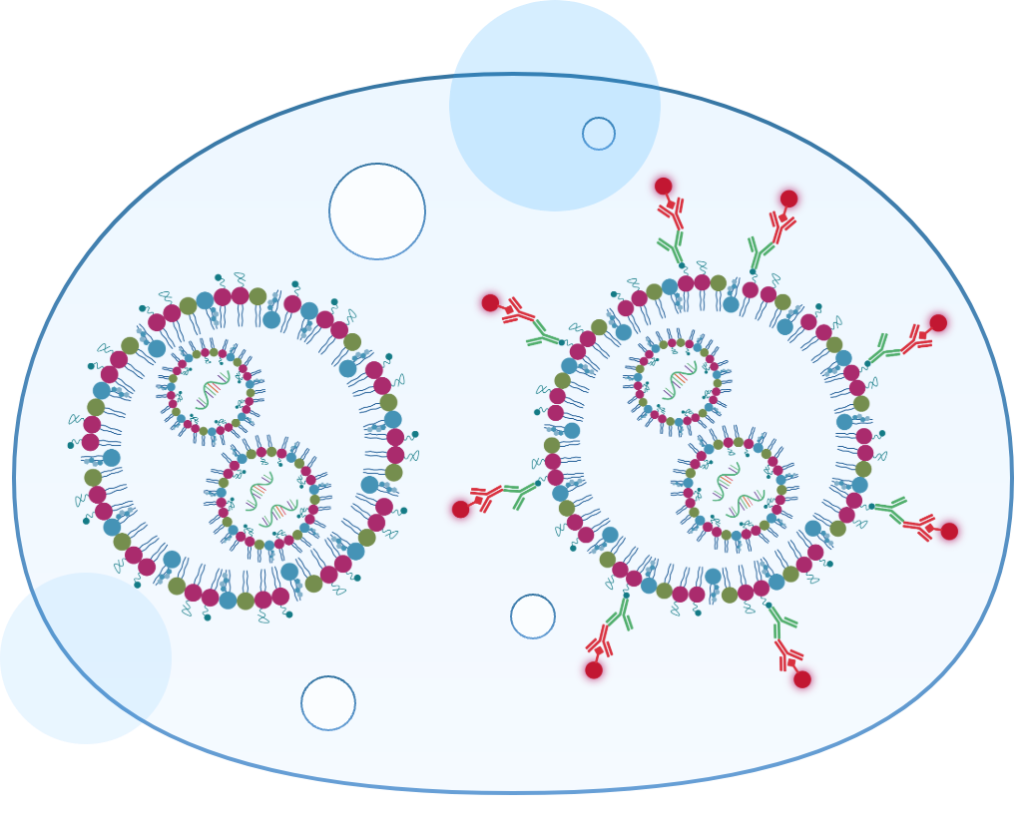
Lipid nanoparticles (LNPs) are the leading non-viral platform for mRNA delivery. Their core–shell architecture encapsulates mRNA and shields it from nuclease degradation and premature leakage in circulation, while the particle surface can be engineered to direct uptake to specific cell types.
Building on this surface tunability, targeted LNPs (tLNPs) display ligands — antibody fragments including single-domain VHHs, peptides, or aptamers — that redirect particles away from the default ApoE/LDLR-driven hepatocyte uptake and toward a chosen cell type, reducing off-target exposure and the dose required for effect.
This makes tLNPs a practical route to in vivo CAR-T therapy. T-cell-targeted tLNPs deliver CAR mRNA directly to T cells in the patient, giving transient, T cell–selective CAR expression without ex vivo manufacture or lymphodepletion. Because the payload is mRNA, there is no genomic integration and therefore no insertional mutagenesis risk; because expression is transient, dosing can be repeated and the CAR construct updated by changing the mRNA payload — provided formulation and CMC are re-qualified for each construct.
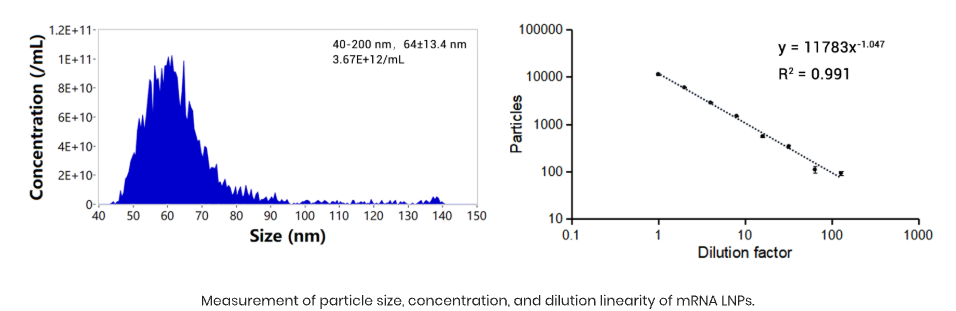
Characterization of mRNA LNPs at the Single-Particle Level
- Label-free size profiling
- Label-free particle size measurement of single LNPs (40–200 nm) in minutes.
- Accuracy & reproducibility you can trust
- Across a serial dilution, NanoFCM counts remain linear with R² = 0.991 (>0.99), confirming quantitative reliability from concentrated stocks to working dilutions.
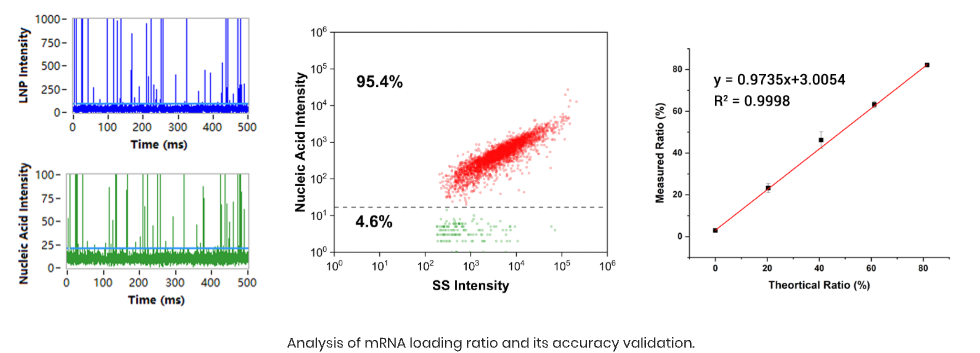
mRNA Loading Ratio
- One run, direct empty/full readout
- Full vs. empty LNPs are resolved and quantified directly.
- Accuracy proven by mixing of mRNA LNPs and empty LNPs
- Measured vs. theoretical loading ratios match with R² = 0.9998.
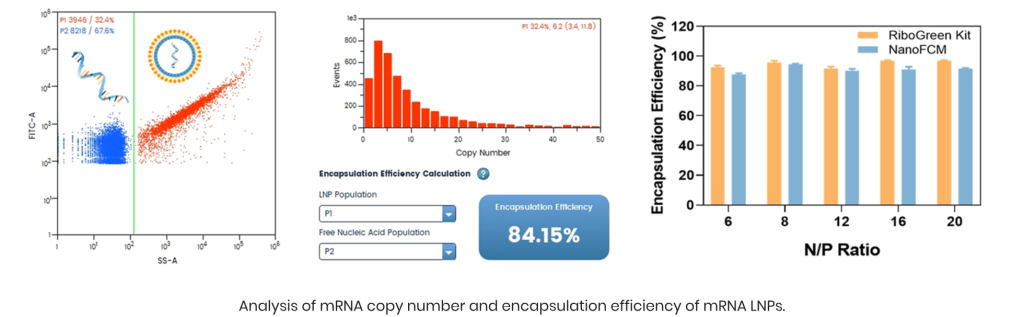
mRNA Copy number and Encapsulation Efficiency
Pharmacopoeia-Grade Encapsulation Efficiency detection— Without Triton X-100
- mRNA copy number
- Payload heterogeneity visible: Each LNP’s mRNA content is measured directly.
- Encapsulation efficiency
- Pharmacopoeia-ready EE in minutes. Results are highly consistent with the RiboGreen assay.
- No harsh surfactants
- Triton X-100-free workflow: safer for operators and the environment.
Characterizing tLNP Targeting: Ligand Copy Number and Density
—Fluorescence labeling meets single-molecule detection—quantifying surface ligand density and protein copy number on mRNA-LNPs.
- Ligand copy number
- A fluorescence quantification strategy resolves the ligand copy number of every LNP directly — no bulk averaging, no inference.
- Ligand Density
- Ligand density (copy number normalized to particle surface area) serves as a key metric of target engagement.
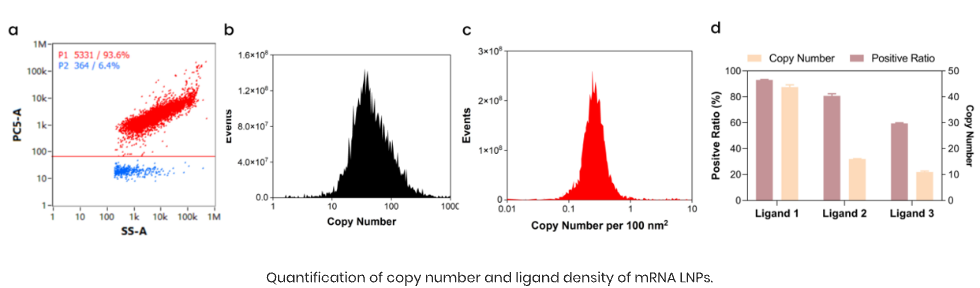
- Chen, C., Zhou, Y., Chen, C., Zhu, S., & Yan, X. (2022). Quantification of available ligand density on the surface of targeted liposomal nanomedicines at the single-particle level. ACS Nano, 16, 6886–6897.
- Hashiba, K., Fukasaka, M., Okuma, C., Kobayashi-Ooka, Y., Kajiwara, K., Sugiyama, A., Mizuno, T., Shimomura, Y., Maeda, Y., Sasaki, J., Enoki, T., Hashino, R., Mikuni, S., Nishita, H., Urushihara, N., Ebe, H., & Yamada, H. (2026). Balancing multivalent avidity and receptor availability governs mRNA delivery by antibody-functionalized lipid nanoparticles. Nano Letters. Published online March 15, 2026.
- Geng, C., Zhou, K., Yan, Y., Li, C., Ni, B., Liu, J., Wang, Y., Zhang, X., Wang, D., Lv, L., Zhou, Y., Feng, A., Wang, Y., & Li, C. (2023). A preparation method for mRNA-LNPs with improved properties. Journal of Controlled Release, 364, 632–643.