 NanoFCM


NanoFCM Precisely Reveals the “Golden Density”
Challenging Conventional Wisdom! The More Antibodies on the Surface of LNPs is Not Always Better—NanoFCM Precisely Reveals the “Golden Density” — Single-Particle Precision that Let Every LNP Functional Ligand “Speak Up”
Antibody functionalization is a key technology for achieving precise mRNA delivery using lipid nanoparticles (LNPs), especially showing great potential in cutting-edge therapies such as in vivo CAR-T. However, a long-standing question in this field remains unresolved: How many antibodies should be coupled to the surface of LNPs to achieve optimal delivery?
In the past, we could only explore this through empirical trial and error, similar to a “black-box operation.” But recently, a groundbreaking study published by the Nitto Denko Corporation’s nucleic acid drug division in Nano Letters provided an answer: Ligand density is not simply positively correlated with delivery efficiency; instead, it follows a classic “inverted U-shape” relationship. The core tool revealing this pattern is single-particle NanoAnalyzer (NanoFCM).
This article will provide a deep dive into this study and explain how NanoFCM is pushing LNP engineering from “Blending of experiences” to a new era of “quantitative design.”
☛Research Background: When “Precise Delivery” Encounters the “Quantitative Blind Spot”
As mRNA therapies expand from infectious disease vaccines to cancer immunotherapies (e.g., in vivo CAR-T), delivering mRNA precisely to targeted cells has become a central challenge. Coupling antibodies (or nanobodies VHH) to the surface of LNPs is a direct strategy for achieving active targeting.
However, traditional characterization methods have critical flaws:
- “Total Amount” ≠ “Functionality”: Traditional BCA or SDS-PAGE methods only measure the total protein content in the LNP suspension and cannot distinguish which antibodies are coupled on the surface and are active, versus those embedded internally or inactivated.
- “Average” ≠ “Single-Particle”: Even if the total surface antibody content is measured, we cannot know the distribution differences of antibodies across individual particles. A large number of empty or low-loaded particles can significantly reduce overall targeting efficiency.
The lack of accurate functional ligand density characterization tools has left Ab-LNP development in the “trial-and-error” stage, leading to results that are difficult to replicate and mechanisms that cannot be fully understood.
☛Technical Breakthrough: NanoFCM—The “Precision Counter” for LNP Functional Ligands
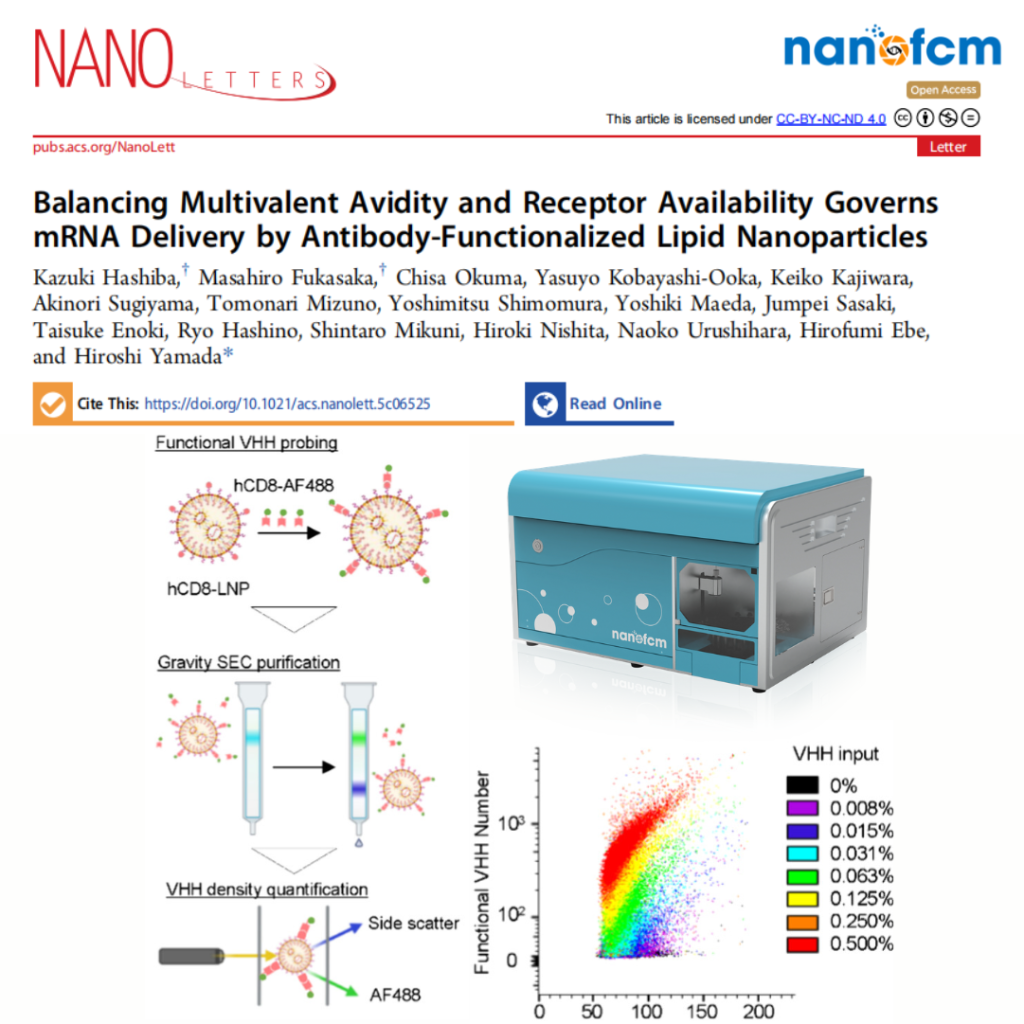
In this study, led by Nitto Denko’s team, researchers developed a VHH-based LNP modification platform and innovatively introduced single-particle NanoAnalyzer (NanoFCM) to solve the above problems.
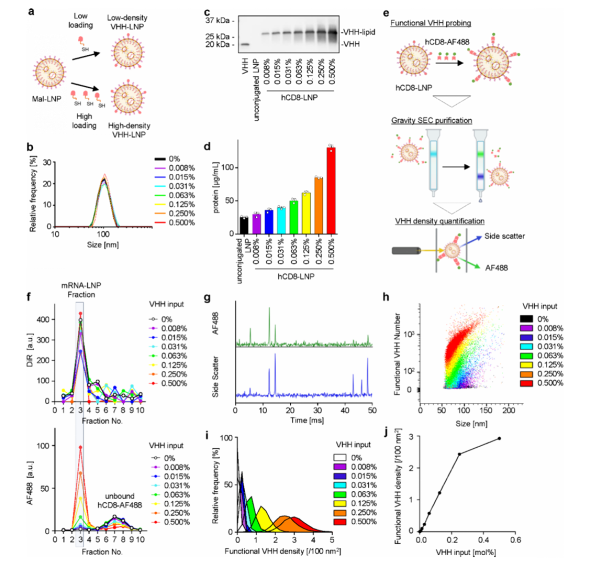
They established a rigorous functional ligand quantification process (Figure 1e):
- Probe Construction: The Ab-LNP is incubated with a fluorescently labeled (AF488) recombinant CD8 protein. Only the surface-active VHHs can bind to CD8 and become “lit up”.
- Single-Particle Detection: After removing free probes using SEC columns, NanoFCM is used to perform dual-parameter detection on individual LNP particles—side scatter (reflecting particle size) and AF488 fluorescence (reflecting the number of bound functional ligands).
- Absolute Quantification: Using standard microspheres for size calibration and ERF fluorescence calibration, the scattering signal is converted into particle size, and the fluorescence signal is converted into absolute molecule counts. Finally, the ligand density per LNP particle is calculated (per 100 nm²).
This method achieves three major breakthroughs:
- From “total protein” to “functional ligands”: Only active antibodies capable of receptor binding are counted.
- From “population average” to “single-particle heterogeneity”: Revealing the distribution of ligand densities across different LNP particles.
- From “relative quantification” to “absolute quantification”: Ligand density becomes a precisely controllable engineering parameter.
☛Key Findings: NanoFCM Reveals the “Golden Density” and Receptor Economics
With NanoFCM’s precise quantification capability, the researchers were able to construct continuous ligand density gradients and systematically explore their relationship with delivery efficiency, leading to several groundbreaking findings.
- Linear Control and Saturation Plateau
- The study found that when the VHH loading ranged from 0.008–0.25 mol%, the surface functional ligand density increased linearly. However, when the loading reached 0.5 mol%, the density plateaued (Figure 1j). This result visually demonstrated the phenomenon of “grafting saturation” on the LNP surface, where blindly increasing loading would just result in waste, a concept that was previously difficult to define clearly.
3.“Inverted U-shape” Delivery Curve
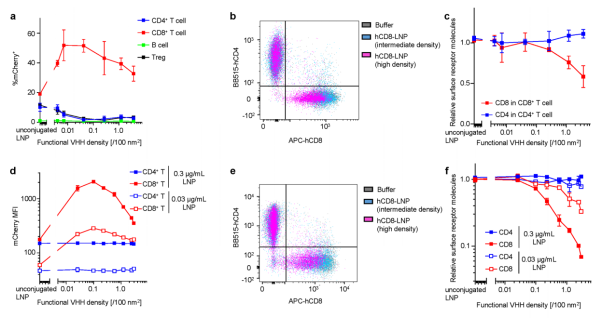
4.After determining functional density, the researchers validated the delivery efficiency both in vitro and in vivo. The results clearly showed that the transfection efficiency of CD8+ T cells followed a classic “inverted U-shape” (Figure 2). When the ligand density was about 0.1 VHH/100 nm², the transfection efficiency in vivo reached the highest value of 51.5%, with minimal off-target effects. Below or above this “golden window” density, delivery efficiency significantly decreased.
☛Mechanism Explanation: High Density Induces Receptor Degradation
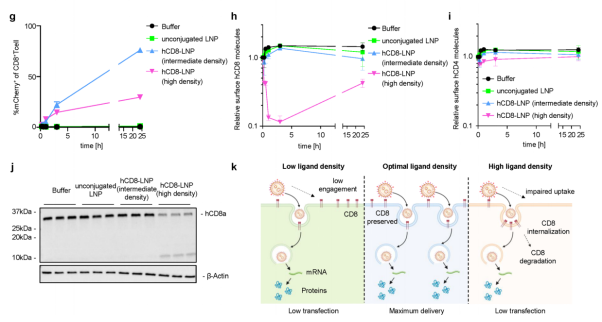
Why is high density harmful? NanoFCM’s quantification results, combined with subsequent flow cytometry and Western blot analyses, revealed the profound “receptor economics” mechanism:
- Low Density: Unable to form effective multivalent binding, making it difficult to drive efficient uptake
- Optimal Density: Achieves a balance between multivalent binding and receptor retention.
- High Density: While it enhances initial binding, it induces rapid endocytosis and degradation of CD8 receptors (59% reduction in CD8 receptor signal within 15-30 minutes, 67% reduction in full-length CD8α protein levels), causing subsequent LNPs to be unable to enter the cells (Figure 3).
4.In Vivo Validation: Remarkable Efficacy at Extremely Low Doses
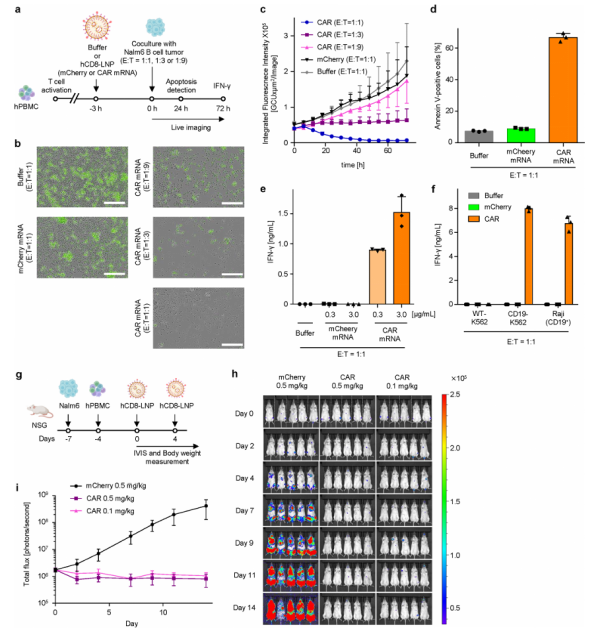
5.The research team loaded mRNA encoding the second-generation clinical-grade CD19 CAR (FMC63 scFv-CD28-CD3ζ) into LNPs with optimal ligand density (0.1 VHH/100 nm²) for CD19 CAR-mRNA delivery. This was tested in a Nalm6 leukemia mouse model, showing its powerful anti-tumor efficacy. The optimal-density CAR-LNP (0.1 mg/kg) treatment group achieved nearly complete tumor suppression, with bioluminescence signals almost disappearing. In contrast, the control group showed rapid tumor progression. No weight loss or other toxic signs were observed during treatment, confirming excellent safety (Figure 4g-i).
☛Research Significance and Translational Value
This study not only brings academic breakthroughs but also has milestone significance for the clinical translation of LNP drugs.
- Establishing a Rational Design Paradigm: It is the first to establish surface functional ligand density as an independent, quantifiable critical quality attribute (CQA), providing the first quantitative benchmark (~0.1 VHH/100 nm²) for Ab-LNP engineering design, ending the era of “empiricism.”
- NanoFCM Becomes the Foundation for Quality Control: This study proves that NanoFCM is the only technology capable of accurately quantifying functional ligands. It should not only be a research tool but also become the standard quality control tool for targeted LNP drug process development, batch release, and stability studies. Without this tool, the “golden density” cannot be validated.
- Empowering Highly Efficient In Vivo CAR-T: CAR mRNA-LNPs designed with optimal density achieved significant therapeutic effects at microgram doses, providing a highly competitive candidate for the clinical translation of in vivo CAR-T therapies.
- Outlook: Making Every Targeted LNP “Evidence-Based”
This Nano Letters article marks a turning point in the field of targeted LNP delivery. It rigorously demonstrates that in the world of nanomedicines, more precise quantification leads to deeper understanding, which in turn guides more rational design.
Throughout the entire study, from the linear regulation of functional ligand density, particle heterogeneity evaluation, precise identification of the optimal delivery window, to in vivo verification of extreme drug efficacy, single-particle NanoAnalyzer (NanoFCM) has been the core data source. It transforms LNP surfaces, once “invisible, uncountable,” into something “visible, countable, and quantifiable.”
As the pioneer and leader in this technology, we firmly believe that NanoFCM will become an indispensable “eye of precision” in the next generation of nanodrug research. If you are engaged in the development of targeted LNPs or other complex nanomedicines, feel free to contact us to explore the infinite possibilities of “quantitative design.”
